
JORGE A. LERA MEJÍA
- A model born at the border
- A binational ecosystem for migration
From Reynosa, Tamaulipas (one of the hemisphere’s busiest migration corridors) the Marcelo Olan Mendoza (MOM) Foundation is taking a natural step in its humanitarian and aid-oriented journey: adding a professional framework of migration services to its social work.
The alliance with the International Migrant Workers Union (IMWU), presided over from Washington, D.C., by Mr. Jesús Sánchez-Cañete and coordinated from Monterrey, Nuevo León, by Mr. Humberto Salinas,launches its operations in July, covering organization, training, and the delivery of specialized advisory services.
The project will be backed by the undersigned, Dr. Jorge Lera, a professor and researcher at the Autonomous University of Tamaulipas (UAT) and a specialist in migration, remittances, and regional border development. My background in applied research, academic publishing, and government consulting will bring essential methodological rigor to the ecosystem: statistical measurement of migration flows and remittances, socioeconomic impact assessment, university partnerships for community service and professional internships, and analysis of the USMCA as a framework for labor mobility.
This is not a matter of sporadic assistance, but rather a permanent support platform based on verifiable standards.
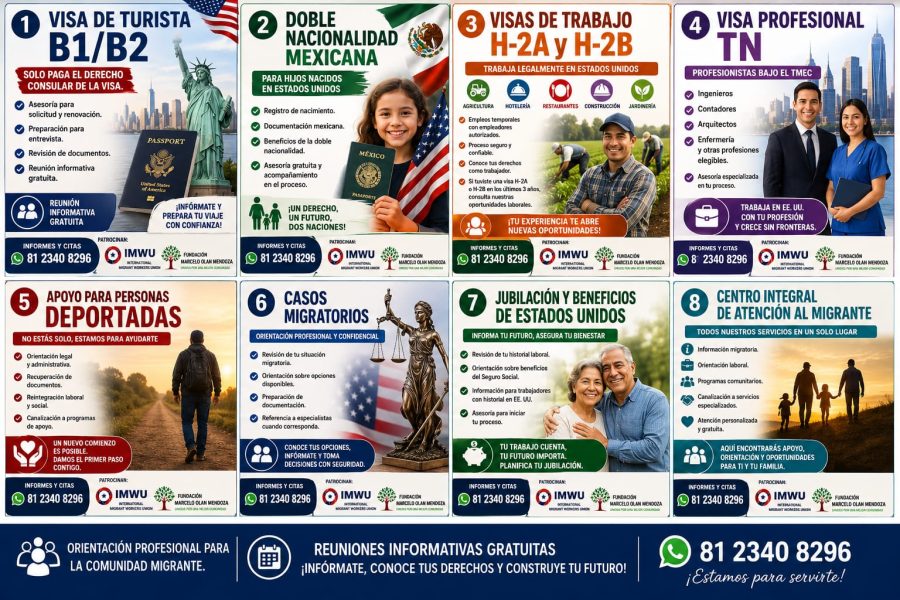
Nine areas, a single point of entry
The operational design covers the full cycle of labor and family mobility: B1/B2 tourist visa management; support for dual citizenship; processing and advisory services for H2A (agricultural) and H2B (non-agricultural) temporary visas; promotion of the TN professional visa—an underutilized avenue under the USMCA; support for deportees with minor infractions; general immigration counseling; guidance for individuals with U.S. retirement benefits; binational tax management and advice; and the operation of the Comprehensive Migrant Assistance Center as a coordinating hub. The scheme’s strength lies in its comprehensive nature: migrants no longer have to shuttle between different offices; instead, they find the legal, labor, tax, and social security pathways required for their specific case at a single location.
A pilot laboratory with a regional scope
Tamaulipas serves here as a laboratory for applied public policy.
The pilot model aims to expand its coverage to Nuevo León, Coahuila, and the rest of the country, and—in a second phase—to Guatemala and Central America, leveraging the U.S. consular network in Matamoros, Nuevo Laredo, and Monterrey.
This logic of orderly expansion allows for documenting lessons learned, measuring results, and replicating what works, rather than improvising responses to each new border situation.
Multidisciplinary human capital
The integrated team (comprising lawyers, accountants, economists, doctors, and engineers with experience in immigration procedures and the remittance ecosystem) constitutes the project’s strategic asset.
The combination of these disciplines is precisely what distinguishes a professional service from a traditional administrative agency: economic analysis allows for assessing actual labor demand; binational accounting prevents double taxation and protects family income; engineering provides process traceability; and legal expertise ensures regulatory compliance in both jurisdictions.
Guiding principles of the ecosystem
Four principles underpin the proposal.
First, the centrality of binational human rights, in adherence to the Global Compact for Migration adopted in Marrakech in 2018, which enshrines safe, orderly, and regular migration.
Second, a paradigm shift: less undocumented status and more regularized employment with benefits, comprehensive services, and oversight of temporary labor recruiters.
Third, union representation by the IMWU; its dialogue with the Departments of Labor and State, as well as with Republican and Democratic lawmakers, offers a rare bipartisan channel in this field.
Fourth, sustainability: a model that is financially viable and socially sustainable, not dependent on short-term subsidies.
Temporary visa data
The H-2A and H-2B window—a strategic asset: The H-2A agricultural program has no numerical cap and reached 398,258 certified positions in fiscal year 2025—an increase of 13,358 over 2024—with less than 0.04% of the vacancies filled by U.S. applicants.
In the first half of fiscal year 2026, 254,688 positions were certified, a 16.9% increase over the previous year.
Mexican nationals secured 91.5% of the H-2A visas and 64.5% of the H-2B visas issued in 2023.
In the non-agricultural category (H-2B), the statutory cap is 66,000 visas annually; for fiscal year 2026, the DHS and DOL authorized up to 64,716 additional supplemental visas via a temporary rule in effect since January 30, 2026, of which 46,226 were reserved for returning workers. The DOL certified 232,434 H-2B positions in fiscal year 2025. Quotas fill up quickly: the second allocation of 27,736 visas closed on April 29, 2026.
Decisive geographic advantage: H-2 visas are processed at only nine consular locations in Mexico, three of which lie within the alliance’s immediate radius—Matamoros, Nuevo Laredo, and Monterrey.
Proposed verifiable goals
Based on this foundation, it is suggested that baseline indicators be established for the first year: facilitating at least 1,500 H-2A/H-2B applications through certified recruiters; providing 3,000 consultations regarding B1/B2 and TN visas, dual citizenship, and binational taxation; and increasing Tamaulipas’s share of total national remittances—currently at 1.6%—by one percentage point. Each percentage point represents more than $600 million in annual household income.
Proposals to consolidate the project
At the outset, it is suggested to: (1) establish a baseline with measurable indicators—such as procedures initiated, visas obtained, cases of deported individuals assisted, and fiscal savings generated; (2) sign collaboration agreements with regional universities—including the UAT—for community service, applied research, and external evaluation; (3) create a certified registry of recruiters and employers who meet labor standards; (4) develop a financial education module linked to the productive use of remittances; and (5) publish a biannual transparency report to strengthen the ecosystem’s institutional reputation.
Conclusion
At a time when borders are being fortified and public discourse is becoming polarized, this alliance proposes something different and necessary: transforming migration into a process that is legal, documented, dignified, and economically productive for families and both nations.
Turning that demand into formal, documented employment with benefits (under the union oversight of the IMWU and the humanistic approach of the MOM Foundation) represents the most solid path to sustaining household income in Tamaulipas while fully respecting binational human rights.